

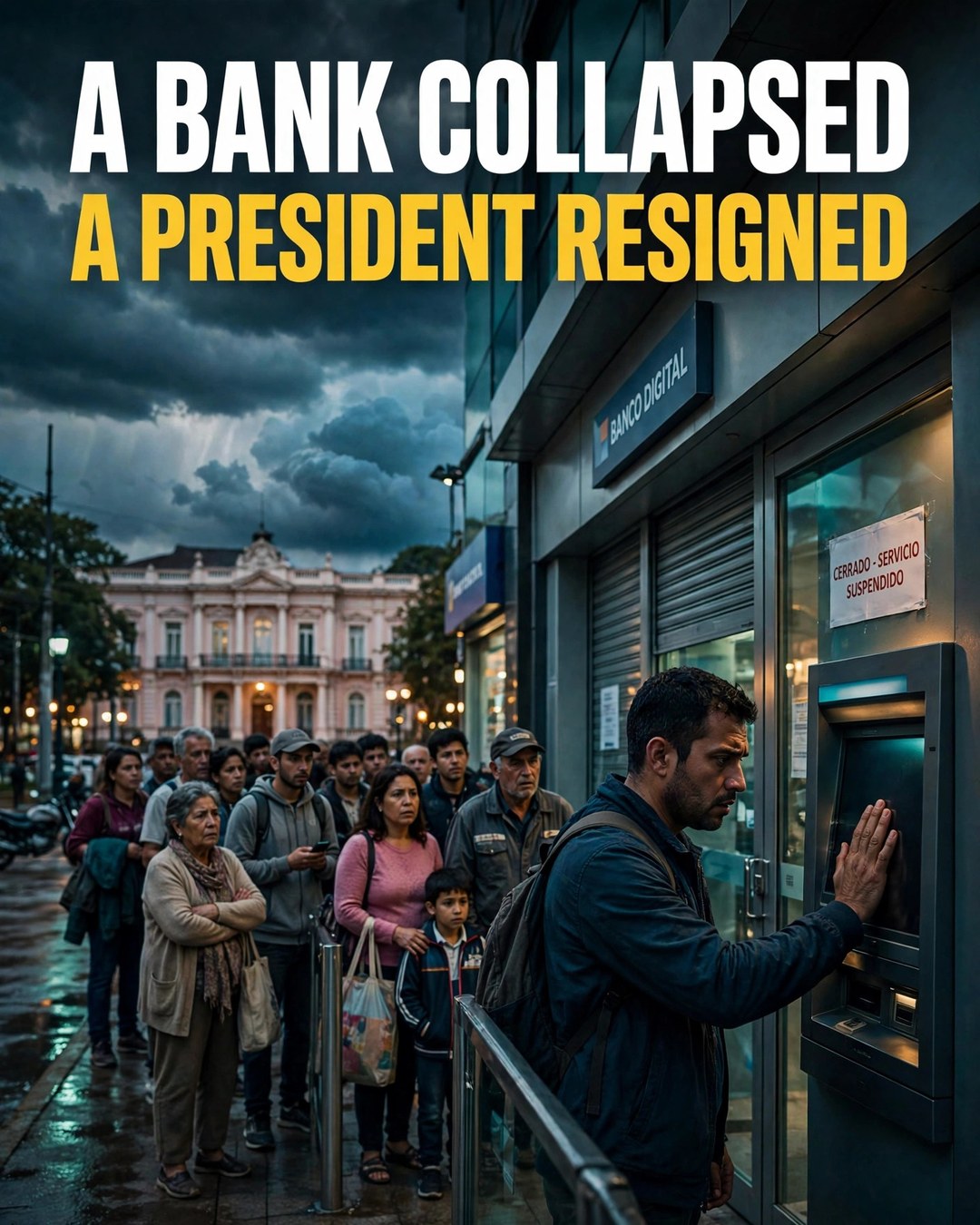
A country of about 6.5 million people, and a bank with about 3 million customers. When that bank collapsed, nearly half the country could not reach its own money — not at a branch, not at an ATM, not on a card. Two days later, the president resigned. Santiago Peña’s fall is the fastest political collapse of the year in Latin America, and it happened in plain sight: a solvency ratio below half the legal minimum, a central bank seizure, street protests, an impeachment vote, and then a pre-recorded video in which the president said no position could be above the country. This is the story of how a digital bank brought down a presidency — and what happens now that a new president has taken over.
The resignation
President Santiago Peña, 47, announced his resignation on Thursday 5 November in a pre-recorded video message. “I have decided to resign as president… no position can be above the country,” he said, adding that he acted “with the stability of our country, social peace and the need to preserve our democratic institutions in mind”.
Peña did not admit any particular wrongdoing. That is an important distinction: he resigned in the middle of a banking crisis and an impeachment process, but the resignation itself contained no admission about the accusations lawmakers had made against him. What he conceded, in effect, was that the crisis had become bigger than his presidency.
The bank that broke
The trigger was ueno, Paraguay’s largest digital bank. The central bank took control of the lender on Tuesday 3 November after its solvency ratio fell to 5.56% against a 12% legal minimum — less than half of what the law requires a bank to hold. About 3 million customers in a country of roughly 6.5 million could not access their accounts, cards or ATMs.
The scale of public exposure made it a national crisis rather than a private failure. Ueno administered close to $850 million in public funds. When a bank holding that much public money cannot let its customers withdraw, the question stops being about banking regulation and becomes about the state itself — which is why the crisis moved, within two days, from the central bank to the presidency.
Impeachment, then the handover
Opposition lawmakers filed an impeachment motion signed by 35 of the 80 lower-house members, and even Peña’s own Colorado Party backed proceedings. The Chamber of Deputies then voted 78–0 to trigger impeachment proceedings, minutes after the resignation was announced.
Congress accepted the resignation, and Vice President Pedro Alliana assumed the presidency. Peña took office in August 2023 for a five-year term, so Alliana completes the term, through August 2028. A new vice president is to be elected after Alliana’s swearing-in, with both chambers meeting in joint session on the resignation. The precise timing of the swearing-in ceremony itself was not confirmed in the wire reports checked, and this article does not state a ceremony time as fact.
The fallout so far
The crisis has already claimed more than the presidency. Central bank president Carlos Carvallo resigned on Tuesday at Peña’s request. Eight ueno executives have been detained, and 26 people have been charged with alleged breach of trust, including all eight board members. Protesters in Asunción were dispersed with pepper spray and rubber bullets on Wednesday night.
Lawmakers accused Peña of conflicts of interest, misuse of pension funds and institutional cover-ups linked to ueno, a bank he had former business links to. Reuters confirmed that Peña was a shareholder until March 2025 in Grupo Vazquez, which controls ueno. Peña is also described as an ally of US President Donald Trump — a detail that gives the crisis a significance beyond Paraguay’s borders, in a region where Washington watches political stability closely.
What comes next is the hard part, and it is not political: roughly 3 million people need their money back, a seized bank needs to be unwound, and a new president needs to show, quickly, that the state can protect depositors better than it protected the bank. The resignation ends one crisis. The banking crisis is still running.
Why did Paraguay’s president resign?
Santiago Peña resigned on 5 November after the collapse of digital bank ueno, which left about 3 million customers unable to access their money. Lawmakers had also moved to impeach him. He did not admit any particular wrongdoing.
Who is Paraguay’s president now?
Vice President Pedro Alliana assumed the presidency after Congress accepted Peña’s resignation. He completes the term, which runs through August 2028.
What happened to ueno bank?
The central bank took control of ueno on 3 November after its solvency ratio fell to 5.56%, against a 12% legal minimum. Ueno administered close to $850 million in public funds, and about 3 million customers could not access accounts, cards or ATMs.