

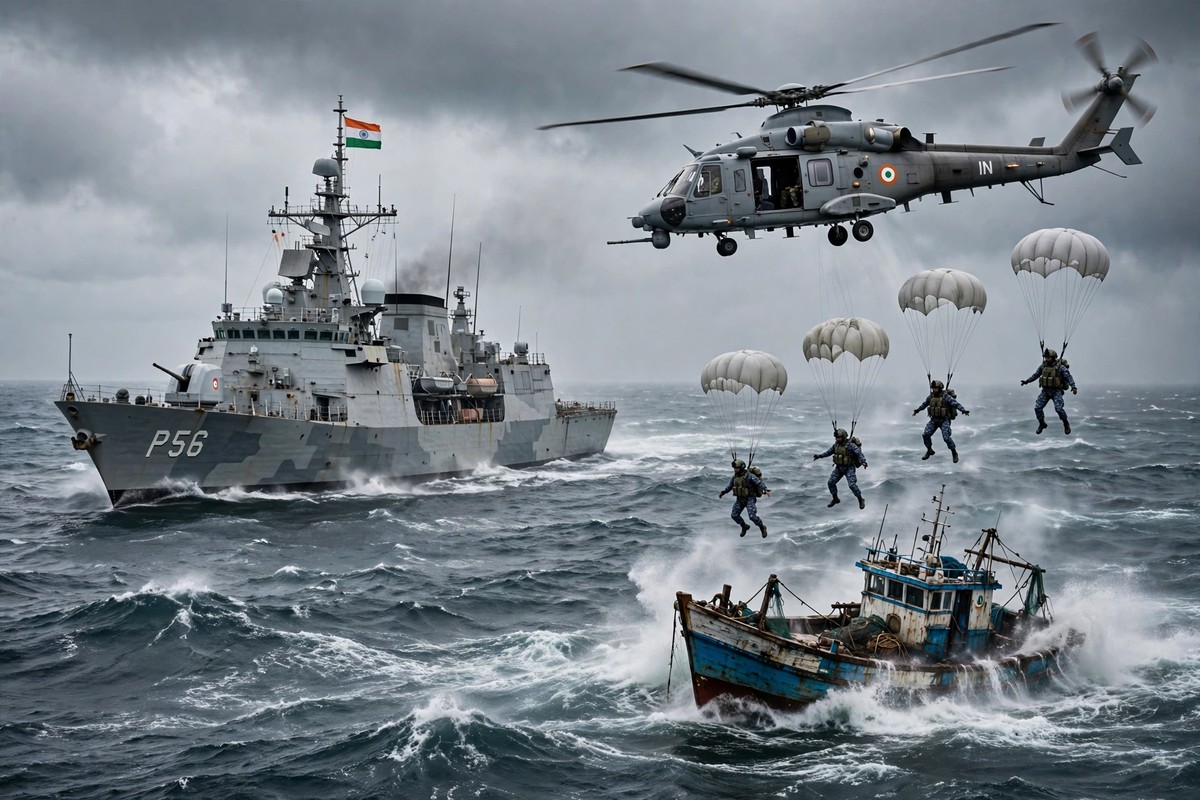
More than 3,000 kilometres from Mumbai, in waters where help is not close at hand, a hijacked fishing boat became a test of reach. On 29 October, armed Somali pirates seized the Iranian fishing vessel Azini. By 2 November, after an operation lasting more than 48 hours, the Indian Navy had freed all 20 of its crew.
⚓ 30-Second Signal — read this, you get the story
⚡Azini was hijacked on 29 October off Somalia, between Bandar Bayla and Hafun.
🎯A 48-hour-plus operation, more than 3,000 km from Mumbai, freed 20 crew — MARCOS parachuted in via a C-17 airdrop.
🔭12 pirates were overpowered, with no casualties reported — but the crew headcount difference is still unexplained.
Tap to reveal what happens next →
Any official clarification on the headcount difference (21 + 2 aboard at hijack vs 20 rescued), and what happens to the pirates.
Tap, scroll and watch the numbers — the full story, with sources, is below. All figures are from the article, no new claims added.
The rescue was announced on 2 and 3 November, and Iran's embassy in New Delhi publicly thanked India on 3 November. It is a story that travels easily — commandos, a transport aircraft, pirates, hostages freed — but the details underneath it are what make it a signal rather than just a headline. This was not a patrol that happened to be nearby. It was a deliberate, long-distance operation, planned around a vessel that authorities feared would be turned into a base for further attacks.
What happened to Azini
Azini was hijacked on 29 October 2026 between Bandar Bayla and Hafun in northeastern Somalia, in the Arabian Sea. The vessel was an Iranian fishing boat, and its seizure by armed Somali pirates raised an immediate concern beyond the fate of its crew: maritime security authorities warned that a hijacked vessel of this kind could be used as a pirate mother ship, a larger platform from which smaller attack boats could be launched for further raids.
That warning, reported via the Maritime Security Centre for the Indian Ocean and the European Union's Operation Atalanta, helps explain why the response was not left to chance or to a nearby commercial ship. A mother ship changes the geography of piracy. It extends range, carries fuel and supplies, and lets pirates operate further from shore for longer. Stopping Azini from becoming one was therefore not only about rescuing its crew, but about preventing the next hijacking.
The operation that followed lasted more than 48 hours. A mission-deployed Navy warship and a maritime surveillance aircraft tracked and monitored the vessel, and Marine Commandos — MARCOS — were parachuted in via an Indian Air Force C-17 precision airdrop. The commandos then stormed and secured the vessel. Twelve armed Somali pirates were overpowered and disabled, according to India's Defence Ministry and Defence Minister Rajnath Singh, as reported by The Indian Express and other outlets.
How a rescue 3,000 km away actually works
Distance is the hardest part of this story to grasp from shore. Three thousand kilometres is not a patrol area. It is a journey that requires fuel, air cover, communications, and a plan for what happens after the boarding team lands on a moving vessel that may be hostile. The C-17 airdrop is the detail that makes the operation legible: rather than waiting for a ship to close the distance, commandos were put into the sea and onto the vessel from the air, with precision timing.
That kind of operation depends on several things working at once. Surveillance has to keep the target in sight. The warship has to be positioned to support the boarding team and to take custody of pirates and crew afterwards. The aircraft has to deliver commandos accurately enough that they land in a position to act, not merely in the water near a hostile vessel. And the whole effort has to be coordinated across the Navy and the Air Force, under rules that prioritise the safety of hostages over speed.
The numbers, and one unexplained difference
| Detail | Reported figure |
|---|---|
| Vessel | Azini, Iranian fishing vessel |
| Hijacked | 29 October 2026, between Bandar Bayla and Hafun, Somalia |
| Rescue completed | 2 November 2026, announced 2–3 November |
| Operation duration | More than 48 hours |
| Distance from Mumbai | More than 3,000 km |
| Crew rescued | 20, reported safe, no casualties among rescued crew |
| Pirates overpowered | 12 |
| How commandos arrived | MARCOS via IAF C-17 precision airdrop |
There is one difference in the reporting that this article will not smooth over. At the time of the hijack, AP and Puntland sources put 21 Iranian crew plus 2 Somali security guards aboard Azini — 23 people in total. The rescue figure is 20 crew freed. The one-person difference, and the fate of the guards, is unexplained in the sources found for this article, and this article does not invent an explanation for it.
There is a related tension in the casualty reporting. India's Defence Ministry said there were no casualties or injuries, a statement that AP notes may cover only the rescued crew. AP also reported that pirates were disarmed, their phones confiscated and they were released, and that three people who came ashore had minor injuries. Those two accounts are not necessarily contradictory, but they are not identical either, and a careful reader should know that the cleanest version — no one hurt at all — is the ministry's version for the rescued crew, not a complete account of everyone involved.
Why Iran thanked India, and why it travels
On 3 November, Iran's embassy in New Delhi publicly thanked the Government of India, the Navy and the Air Force for rescuing the 20 Iranian crew. That public thanks matters diplomatically, because it turns a military operation into a public signal: India acted, at distance, for the crew of another country's vessel, and that country acknowledged it openly.
For readers in India, the story also lands for a simpler reason. It is a clear, complete narrative in a news cycle full of incomplete ones. A hijacking happened, a plan was made, commandos arrived from the sky, hostages walked free, and a foreign government said thank you. There is no ambiguity about the outcome for the rescued crew, even if some details around the edges remain unexplained. That completeness is part of why it travels on social media — a short video or a single image of a C-17 or a warship can carry the whole story, and the full article is where a reader goes to understand how it actually worked.
For the wider Indian Ocean, the signal is deterrence. Piracy off Somalia has not disappeared, and a successful mother-ship seizure would have extended its reach. By taking Azini back, the operation removed that platform and demonstrated that distance alone does not put a hijacked vessel beyond reach. Whether that deters the next group of pirates is a question for the months ahead, not something this article can answer today.
What to watch next
The immediate questions now are practical, not dramatic. What happens to the 12 pirates who were overpowered? What happens to Azini itself, and to its crew's return home? And will the unexplained headcount difference be clarified by Indian or Iranian authorities? Those are the follow-ups worth watching, rather than a search for more dramatic detail about an operation that is already complete.
Azini will likely fade from headlines quickly, as rescue stories do once the hostages are safe. That is normal. But as a signal, it belongs in the same category as other long-distance Indian Navy operations in the region: a reminder that maritime security is not only about ships near a coastline, but about the ability to act, quickly and precisely, thousands of kilometres away, when a crew's life depends on it.
When was Azini hijacked, and when was it rescued?
Azini was hijacked on 29 October 2026 between Bandar Bayla and Hafun in northeastern Somalia. The rescue was completed on 2 November 2026, after an operation lasting more than 48 hours, and announced on 2–3 November.
How were the crew rescued?
A Navy warship and surveillance aircraft tracked the vessel, and Marine Commandos (MARCOS) were parachuted in via an Indian Air Force C-17 precision airdrop, then stormed and secured Azini. Twenty crew were freed and 12 pirates were overpowered.
Why is there a difference between 23 people aboard and 20 rescued?
At hijack, AP and Puntland sources put 21 Iranian crew plus 2 Somali security guards aboard, while the rescue figure is 20 crew freed. The difference is unexplained in the sources found for this article, and this article does not invent an explanation.