

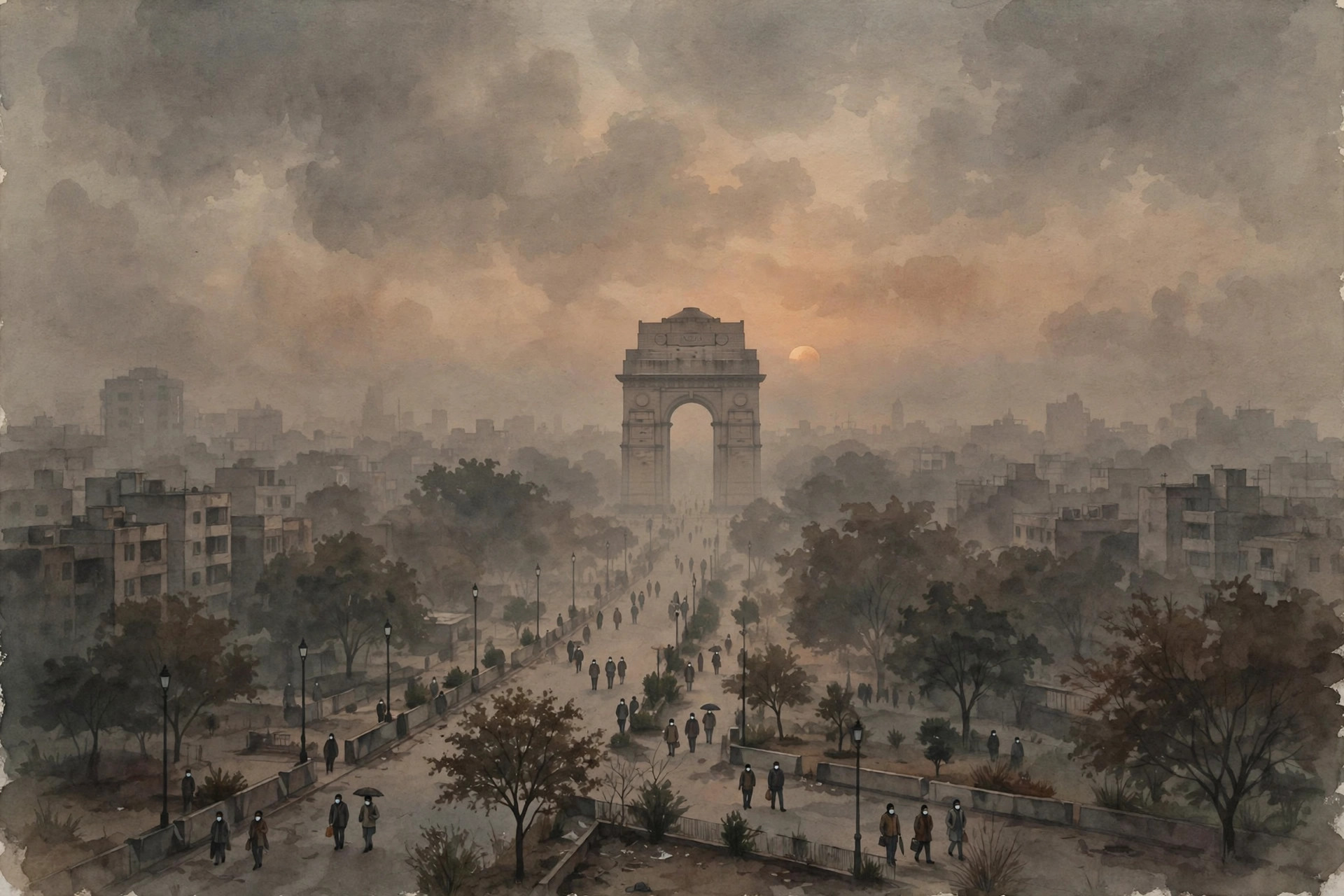
Delhi’s air did not turn bad overnight. It slid, day by day, through the categories the Central Pollution Control Board uses to describe it — moderate, then poor, then very poor — until, on 3 November, it recorded its worst reading in 287 days. The slide matters because it arrived just before Diwali, when firecrackers, winter weather and stubble burning collide, and because the official response has tried to do two things at once: tighten emergency curbs, and allow a narrow, regulated window for green crackers. Understanding the timeline, the rules and what is still only a morning reading is the difference between panic and a plan.
The timeline — and a correction worth making
Delhi’s daily AQI, as reported from CPCB data, was 117 (moderate) on 31 October, 261 (poor) on 1 November, 324 (very poor) on 2 November and 350 (very poor) on 3 November. That sequence corrects a common shorthand: Delhi crossed 250 on 1 November, not first on 2 November. What happened on 2 November was the next step — crossing 300 into the “very poor” band.
The distinction between a morning reading and a daily value matters just as much. On the morning of 2 November, the 24-hour average at 8 a.m. was 310; the day’s official value, taken from the 4 p.m. bulletin, was 324. On the morning of 4 November, the city reading was 373 at 7 a.m., with 54 of 59 reporting stations above 300 and 21 above 400 — but that is a real-time morning reading, not the final daily AQI for 4 November, which had not been published at the time of reporting. Presenting a morning reading as the day’s final figure is one of the easiest ways to mislead on air quality, and it is worth resisting.
On 3 November, the picture was at its worst in the data reported so far: a city AQI of 350, the worst in 287 days, with the last higher reading 378 on 20 January 2026. Of 57 stations, 10 were “severe”, 35 “very poor” and 12 “poor”. Jahangirpuri was worst at 462, followed by Punjabi Bagh at 445 and Rohini at 442. The CPCB scale runs 0–50 good, 51–100 satisfactory, 101–200 moderate, 201–300 poor, 301–400 very poor and 401–500 severe — so by 3 November, most of the city was not merely in a bad band, it was in the second-worst one, with pockets in the worst.
What Mumbai and Kolkata showed
A snapshot of six major cities on 2 November put New Delhi at 275 (poor), Kolkata at 155 (moderate) and Mumbai at 144 (moderate). The source itself warned that these are snapshot readings at a particular time, varying by location and hour, not CPCB daily bulletins. They are useful for one point only: Delhi’s problem in early November was not a national one at the same intensity. Other metros were elevated, but they were not in Delhi’s band.
GRAP Stage II — what it actually does
The Commission for Air Quality Management invoked GRAP Stage II across Delhi-NCR with immediate effect on 2 November, after AQI reached 324. Stage II is the stage that applies when AQI is between 301 and 400. The measures reported include intensified mechanised road sweeping, water sprinkling with dust suppressants, anti-smog guns, higher parking fees, staggered timings for government offices, stricter regulation of diesel generators, more public transport, and a ban on coal and firewood in tandoors in hotels and restaurants.
Separate winter measures from 1 November included restricting entry of non-BS-VI vehicles registered outside Delhi and “No PUC, No Fuel” enforcement. GRAP is often described as if it were a single switch; in practice it is a ladder, and Stage II is a mid-rung response — stronger than the dust-control measures of Stage I, but short of the construction bans and vehicle restrictions that come at higher stages. Whether Stage II is enough depends on what the next few days’ readings do, which is why the forecast matters: the Air Quality Early Warning System forecast “very poor” for 4–6 November, with a six-day outlook of “very poor” to “severe”.
The green-cracker order — narrow, timed, conditional
On 2 November, a Supreme Court bench of Justices M.M. Sundresh and P.B. Varale allowed the sale and bursting of certified green crackers in Delhi-NCR only on 7 and 8 November, between 6–7 a.m. and 8–10 p.m., with a complete ban reinstated from 9 November. No bursting is allowed within 300 metres of hospitals, nursing and old-age homes, health centres, educational institutions and notified silence zones, called “No-Cracker Zones”. Only CSIR-NEERI-listed products are allowed, with product-specific QR codes; manufacture is permitted from 2–6 November by CSIR-NEERI and PESO-certified makers; there are no online sales, no “laris” (series crackers) and no barium.
The court’s reasoning, as reported, was that the earlier blanket ban had neither significantly improved air quality nor stopped illegal sale and use of conventional crackers, and that there was inadequate data to decide that a complete ban was best. Hence the regulated permission, plus CPCB AQI reports for 2–6 November, 7–8 November and 9–30 November, so the effect can be judged from data rather than assertion. That is a testable order: if the 7–8 November readings spike in a way the 2–6 November readings did not, the court will have the evidence in front of it.
Why the air got this bad
CAQM cited unfavourable meteorological conditions for the rise. Winter factors — lower wind speeds and falling temperatures — trap pollutants close to the ground, and they arrive in the same weeks as stubble burning in October–November, festive firecrackers, vehicles and dust. The IITM Decision Support System, reported on 3 November, apportioned Delhi’s pollution as stubble burning 15.3 percent, transport 15.8 percent, industries 3 percent, residential 3.9 percent, construction 2.2 percent, road dust 1.2 percent, waste burning 1.4 percent and energy 1.2 percent. Satellites detected 219 farm fires across six states on 2 November — 98 in Punjab, 67 in Rajasthan, 48 in Madhya Pradesh, 4 in Uttar Pradesh and 2 in Haryana.
What to do, and what not to over-claim
Dr Randeep Guleria of Medanta, Gurugram, quoted on 4 November, said severe pollution is a major challenge for people with chronic respiratory or cardiovascular conditions, children and the elderly, and that even healthy people may experience chest tightness, breathlessness, watering eyes and coughing. His advice was to avoid outdoor exercise when air is poor, use N95 masks outside, continue prescribed medication and inhalers, and consider air purifiers indoors. That is expert advice quoted in press coverage; no verified official Delhi government health advisory document was found in the sources for this article, and the advice is not attributed to one here.
The honest summary for 4 November is this: Delhi is in “very poor” air, under GRAP Stage II, with a forecast that does not promise quick relief, and with a two-day, tightly timed green-cracker window ahead that will itself be measured. The next numbers that matter are the 4 p.m. daily bulletins, the 7–8 November readings, and the CPCB reports the Supreme Court has asked for — not the morning snapshot, and not a single station’s worst hour.
What is Delhi’s AQI now?
The daily (4 p.m. bulletin) AQI was 350, very poor, on 3 November 2026. The 4 November morning real-time reading of 373 at 7 a.m. is not the final daily value.
What is GRAP Stage II?
The second stage of the Graded Response Action Plan, invoked by CAQM on 2 November for Delhi-NCR when AQI is 301–400, covering dust control, transport, generator and tandoor measures.
When are green crackers allowed in Delhi-NCR?
Only on 7 and 8 November 2026, 6–7 a.m. and 8–10 p.m., certified green crackers only, with a complete ban again from 9 November.