

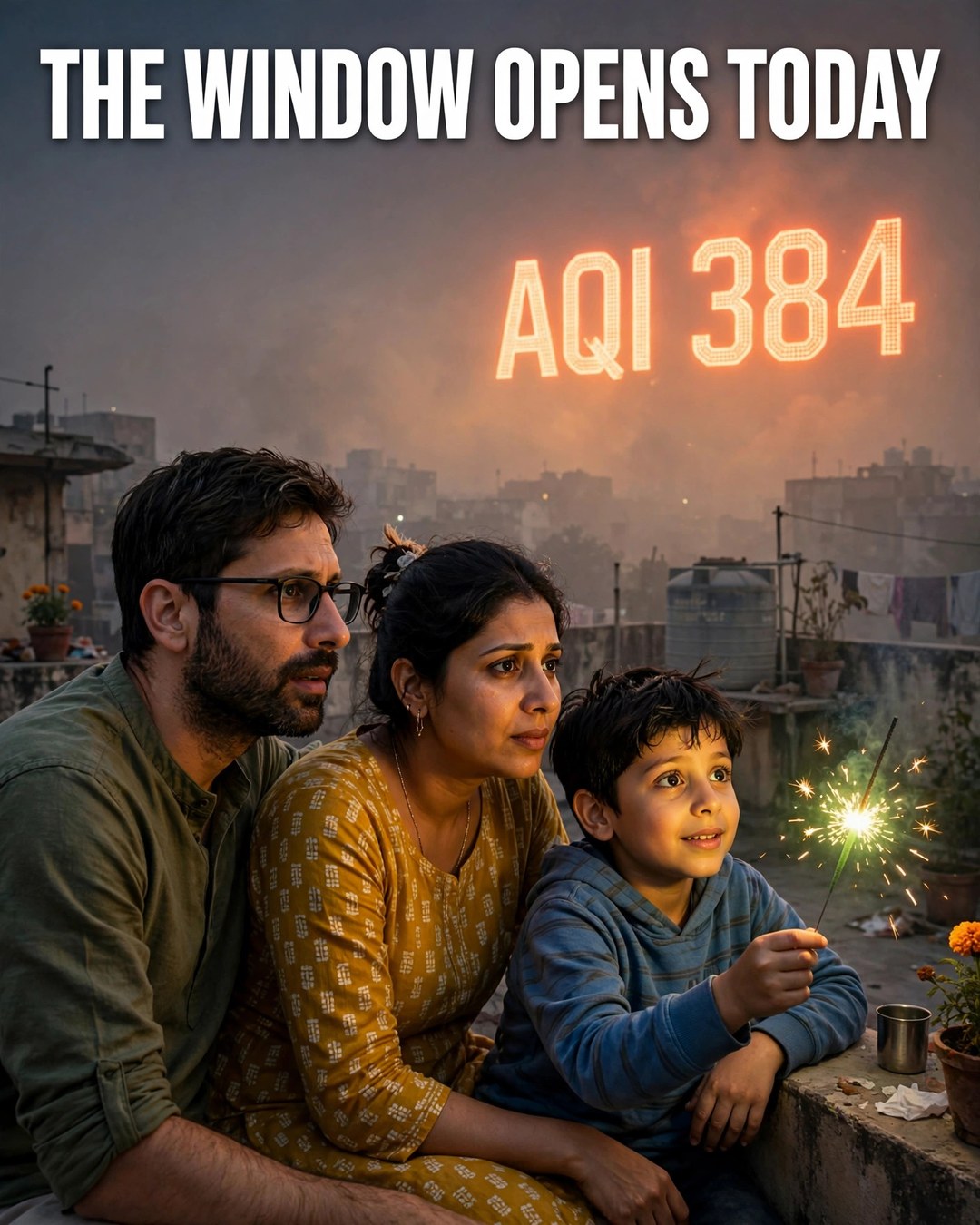
Delhi has now spent five straight days breathing very poor air. On Saturday, the city got its first chance in years to burst crackers legally — and on Sunday morning, Diwali day itself, it woke to the worst air of the week so far. The Central Pollution Control Board put the overall AQI at 384 at about 6–7 in the morning, very poor.
Saturday: stuck in the mid-360s
On Friday, 6 November, the Central Pollution Control Board’s readings told the story of a city stuck. On Friday morning it climbed — 387 at 7 a.m., 389 at 8 a.m., 391 at 9 a.m. — then eased to about 382 by 4 p.m., but never left the very poor band of 301 to 400.
Saturday, 7 November, brought no relief. The CPCB 24-hour average on Saturday morning was in the mid-360s — 364 on one reading, 369 on another — still very poor. That made it the fifth straight day of very poor air, and Saturday was also the first day green crackers were allowed in Delhi-NCR. One honest note: a weather.com live reading of 316 is not a CPCB figure and is not quoted as one here.
Diwali morning: 384 at 6 am — and 483 by 8:10 am
Delhi woke on Diwali morning, Sunday 8 November, to a thick blanket of smog. According to the CPCB, the overall AQI was 384 at about 6–7 a.m., very poor. Of the 23 stations in the 6 a.m. update, 11 recorded AQI above 400, severe. The worst were Jahangirpuri at 450, Punjabi Bagh at about 449, RK Puram at about 448, Bawana at 446 and IIT Delhi at about 445.
Then came a figure that needs flagging honestly. A later CPCB reading put the city’s AQI at 483 at 8:10 a.m., severe, as reported by ANI. That is odd: 483 is higher than every individual station reading in the same reports, where the worst station was 450. Both figures are therefore given with their times, not blended into one number. On the CPCB scale, 301–400 is very poor and 401–500 is severe.
GRAP-III and the green-cracker window
The Commission for Air Quality Management invoked GRAP-III, the third stage of the Graded Response Action Plan, on Friday 6 November as a precautionary measure, bringing construction and demolition curbs and hybrid classes up to Class 5. Schools in Delhi and five neighbouring NCR cities were told to run classes up to Class 5 in hybrid mode.
Under the Supreme Court’s order of 2 November, certified green crackers are allowed in Delhi-NCR only on 7 and 8 November, and only between 6 and 7 in the morning and 8 and 10 at night. The full ban returns on 9 November. Only CSIR-NEERI-listed products with QR codes are allowed; no online sales, no series crackers, no barium, and no bursting within 300 metres of hospitals, schools and silence zones. The Supreme Court also ordered separate air-quality assessments for three periods — before Diwali, 7–8 November, and 9–30 November.
Why tonight is the worst test
What is coming is in the forecast from the India Meteorological Department and IITM’s Air Quality Early Warning System: severe air on 7, 8 and 9 November, then severe to very poor for the six days after that. The number that explains why is the ventilation index — how well the atmosphere can disperse pollution. On Saturday it is 13,500 square metres per second. On Sunday, Diwali day, it collapses to 3,000. On Monday it recovers only to 4,000.
The question is not whether people will burst crackers — they will — but whether the green crackers, the restricted hours and the GRAP-III curbs together can keep the night from becoming the worst of the year. The forecast says the odds are against it. If Sunday night stays merely very poor, that counts as the experiment working; if it goes severe, the debate will be whether any window can work in air like this.
What people in Delhi can actually do
For people in Delhi, the practical advice is unchanged from every Diwali before this one, and it is worth repeating because it is the only part of this story anyone can control: keep children and elderly people indoors on Sunday night, keep windows closed through the worst hours, and do not assume that a cracker labelled green is a cracker that does not pollute. Green crackers pollute less than ordinary ones — less is not harmless, and at a ventilation index of 3,000, even less adds up fast.
Dr Randeep Guleria of Medanta, Gurugram, quoted in press coverage, said severe pollution is a major challenge for people with chronic respiratory or cardiovascular conditions, children and the elderly, and that even healthy people may experience chest tightness, breathlessness, watering eyes and coughing. His advice: stay indoors when air is poor, use N95 masks outside, keep taking prescribed medication, and consider air purifiers. Delhi’s air was already very poor before a single cracker was lit.
What was Delhi’s AQI on Diwali morning?
The CPCB overall AQI was 384 at about 6–7 a.m. on Sunday 8 November, very poor, with 11 of 23 stations above 400. A later CPCB reading put the city at 483 at 8:10 a.m., severe, per ANI.
What is GRAP-III?
The third stage of the Graded Response Action Plan, invoked by CAQM on Friday 6 November for Delhi-NCR, covering construction and demolition curbs, hybrid classes up to Class 5 and other restrictions.
When are green crackers allowed in Delhi-NCR?
Only on 7 and 8 November 2026, 6–7 a.m. and 8–10 p.m., certified green crackers only, with a complete ban again from 9 November.