

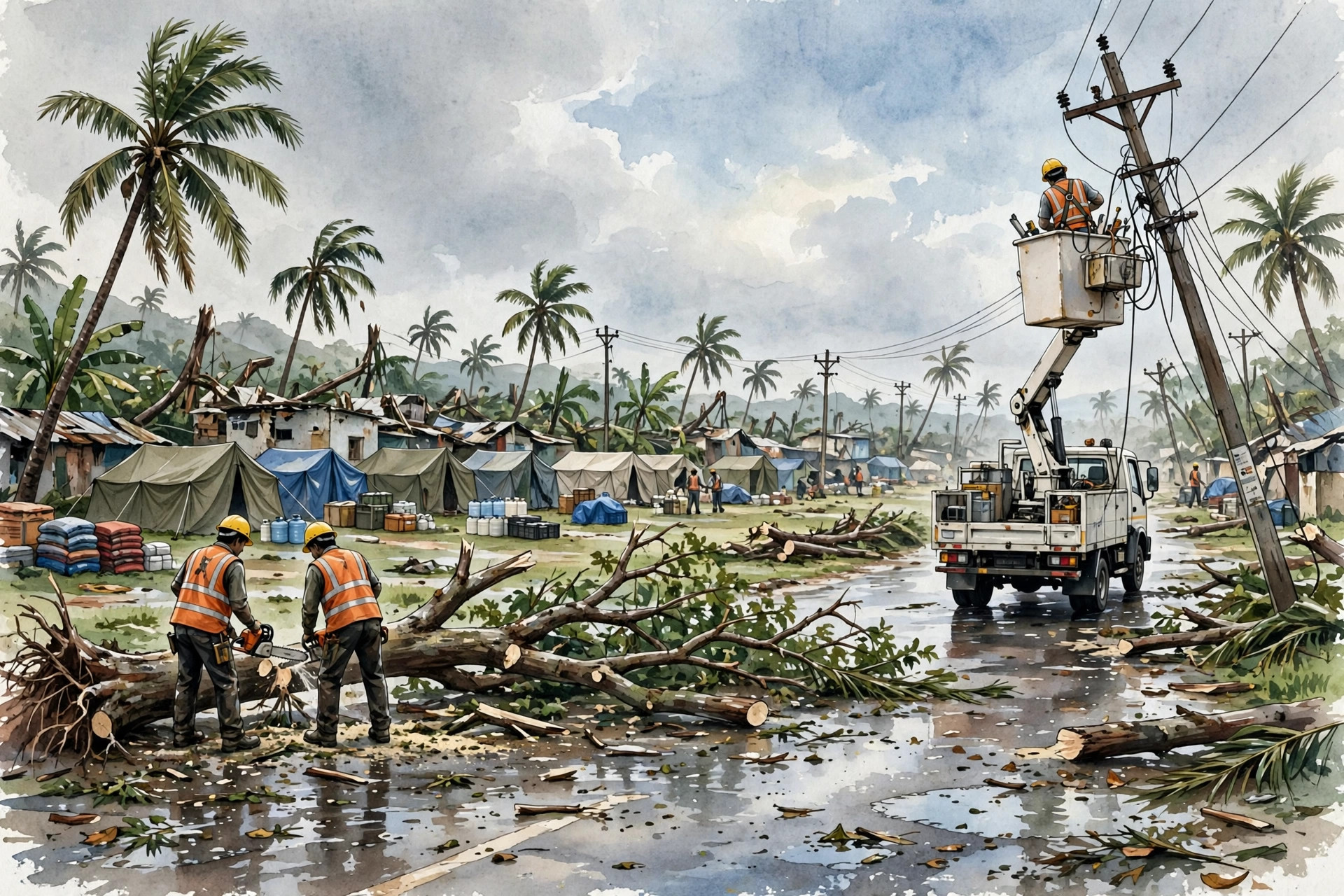
The storm has a name, a landfall time and a wind speed. Recovery does not. By the morning of 4 November, Cyclone Murasu — which crossed the south Andhra Pradesh coast in the early hours of 3 November — had weakened to a depression over east Telangana, and the immediate danger had moved on. What remained, in the districts it hit hardest, was the slower work that follows every cyclone: restoring power, clearing roads, counting damaged crops and houses, and looking after the 12,230 people who were in rehabilitation centres when the last sourced count was taken. This is an update, not a repeat of the landfall story: it focuses on what happened after the wind, what is being restored, and which numbers are still only preliminary.
The landfall, briefly
Severe Cyclonic Storm Murasu crossed the south Andhra Pradesh coast between Nellore and Narasapur, close to Ongole, between 3:30 a.m. and 5:30 a.m. on Tuesday, 3 November 2026, with winds of 100–110 kmph gusting to 120 kmph, according to the India Meteorological Department as reported by NDTV and Mathrubhumi. The Hindu separately reported the observed maximum sustained wind at landfall as 110–120 kmph. The small difference between those wind descriptions is normal — gust and sustained wind are different measures — and both point to the same fact: a severe cyclonic storm, not a marginal one.
Rainfall was extreme in places. Prakasam and Bapatla received very heavy rainfall of around 200 mm between midnight and 6 a.m. on 3 November, and Marripalem in Palnadu recorded 263.75 mm between 8:30 a.m. and 9 p.m. on 3 November. That rain, as much as the wind, is what damaged crops, flooded low-lying areas and brought down trees and poles across the affected districts.
Two deaths, and why the count is stated carefully
At least two people died in cyclone-related incidents in Andhra Pradesh, both in Bapatla district: a 25-year-old man in Chinnaganjam and a 65-year-old woman in Karamchedu, after buildings collapsed on them, according to APSDMA Managing Director Prakhar Jain, as reported by PTI and The Hindu.
The count is stated that way deliberately. A 4 November report in The New Indian Express mentioned one person dying in Uppugunduru in Prakasam in a shed collapse, while The Hindu’s Prakasam report said no human casualties were reported in that district. Those two accounts conflict with the statewide two-death APSDMA figure, and this article does not add the third death to the total without official confirmation. In the aftermath of a cyclone, casualty figures are revised as reports come in from districts; adding an unconfirmed death to a sourced total would create a false precision that later correction cannot fully undo.
The preliminary damage picture
Preliminary assessment put monetary loss at Rs 344 crore, with standing crops damaged across 52,459 hectares and 312 houses damaged, per Jain and APSDMA. The cyclone affected 132 mandals in 15 districts. Relief work at that stage included 171 relief camps, 14,810 food packets distributed, and 11 National Disaster Response Force and 13 State Disaster Response Force teams deployed, according to the state government and official releases.
Every one of those figures is preliminary, and the research for this update found evidence of why that label matters: a later Chief Minister’s Office post cited Rs 343.95 crore and 50,473 hectares in a different scope, showing that totals are still moving as assessments are refined. A combined figure of Rs 4,526 crore and about 31,000 poles reported in some 4 November coverage covers two cyclones, Arnab and Murasu, together — it is not a Murasu-only figure, and it is not used as one here.
The rehabilitation figure that can be sourced is 12,230 people in rehabilitation centres in Guntur, Bapatla and Palnadu, the worst-affected districts, according to Jain. No updated 4 November shelter number was found in the sources read for this update, and none is invented here. The latest sourced shelter figure remains the 3 November figure of 12,230, and it should be read as that — a count at a point in time, not a live total.
Power, roads and transport: what is being fixed
Power infrastructure took a direct hit: 2,750 electricity poles were damaged, with transmission lines, sub-stations and distribution systems disrupted, particularly in Prakasam and Bapatla. In Prakasam’s Ongole Circle alone, preliminary damage was put at Rs 3 crore, with nearly 1,200–1,300 poles and around 200 transformers damaged.
Restoration in Prakasam, as reported on 3–4 November, was under way but incomplete. Fallen trees were cleared and traffic movement restored; power was restored to most areas by Tuesday, though many localities remained without electricity. In Ongole city, power was restored to nearly half the city, with full restoration in affected areas expected by Tuesday night or by 10 a.m. Wednesday — an expectation, not a confirmed completion, and no confirmed 4 November completion figure was found. Reporting an expected target as a completed restoration would mislead residents waiting for power, and it is not done here.
Transport was disrupted on 3 November, with more than 35 trains cancelled, 14 diverted and 8 rescheduled, and several flights cancelled. South Coast Railway said on 3 November evening that train services were gradually resuming in affected areas. For travellers, “gradually resuming” is the operative phrase: it means services are returning, not that the timetable is back to normal.
Where the storm is now, and what remains
The remnant of Murasu weakened into a depression by 5:30 a.m. on 4 November over east Telangana and the adjoining Andhra coast, about 30 km south of Khammam, and was expected to weaken into a well-marked low within 12 hours. Heavy to very heavy rain remained likely at isolated places in north coastal Andhra Pradesh and east Telangana on 4 November; rain warnings for south coastal Andhra Pradesh and Rayalaseema were lifted, and fishermen were advised to stay off the Andhra coast until noon.
Union Home Minister Amit Shah spoke to Chief Minister N. Chandrababu Naidu on 3 November and assured all possible central assistance, with NDRF and SDRF teams on the ground. That central-state coordination is the framework for the next phase, but the next phase itself — final damage assessment, compensation, and full restoration — will be measured in days and weeks, not in the hours after landfall.
For readers in the affected districts, the useful summary is short: the storm has weakened, the danger from wind has passed, rain risk remains in the north coastal areas for 4 November, power restoration is partial and ongoing, and the damage and shelter figures you see are still preliminary. The next update that matters will not be a new wind speed — it will be a confirmed restoration date, a final damage total, and a compensation announcement, none of which should be guessed at before they are published.
How many people are in relief centres after Cyclone Murasu?
12,230 people were in rehabilitation centres in Guntur, Bapatla and Palnadu, according to APSDMA. That is the latest sourced figure, from 3 November; no updated 4 November shelter number was confirmed in the sources read.
What is the preliminary damage from Murasu?
Preliminary loss of Rs 344 crore, crops damaged on 52,459 hectares, 312 houses damaged and 2,750 electricity poles damaged. All figures are preliminary and subject to revision.
Where is Cyclone Murasu now?
By 5:30 a.m. on 4 November it had weakened to a depression over east Telangana, about 30 km south of Khammam, expected to weaken further within 12 hours.