
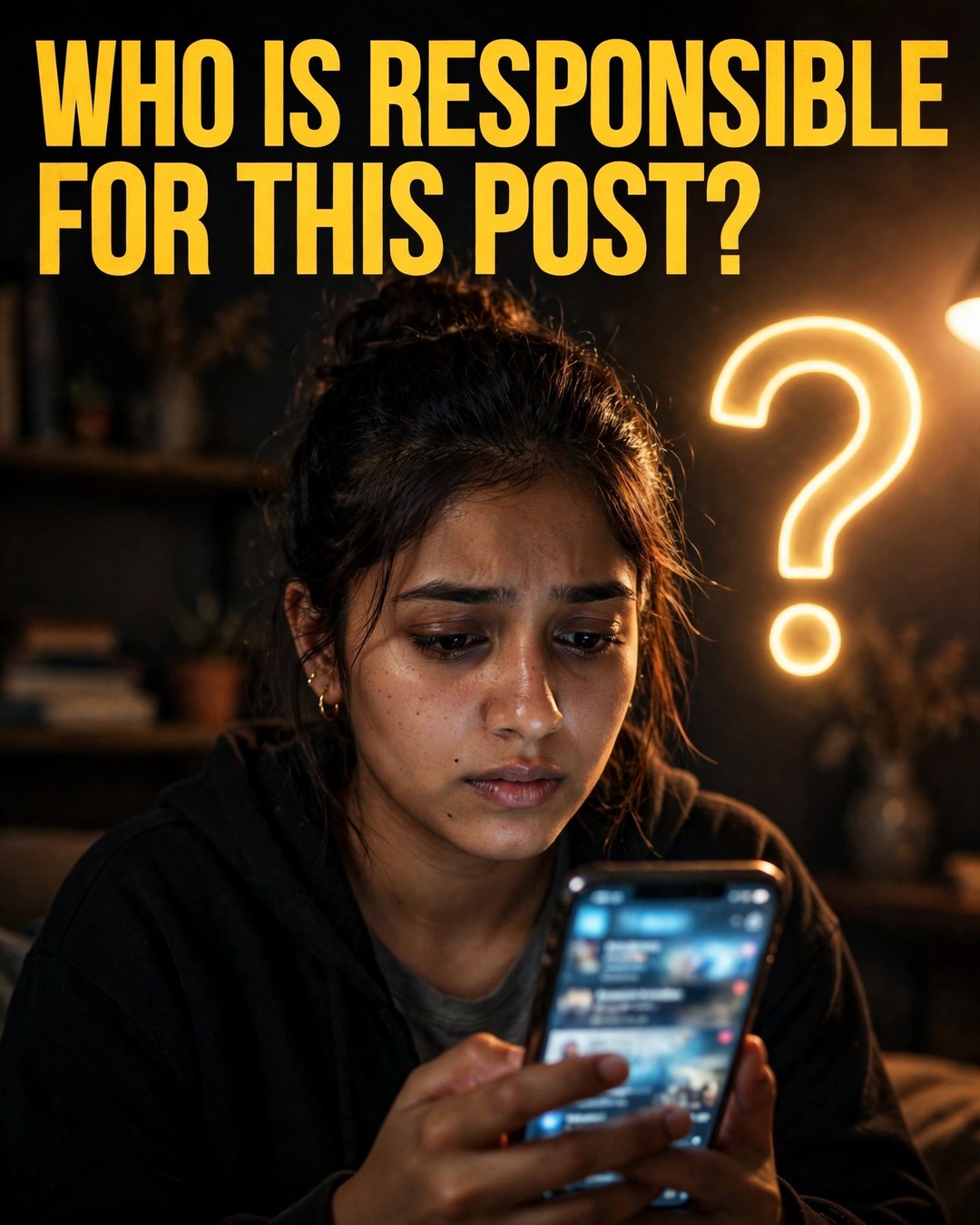
If you post something on Facebook, Instagram, YouTube or X that someone says broke the law, who is responsible — you, or the platform? For more than two decades, the answer in India has mostly been: you. The platform could say, in effect, “not our post.” That protection is called safe harbour, and the government is now discussing whether social media companies should keep it. The discussions have begun, but no decision has been taken. Nothing has changed yet.
What safe harbour actually means
Safe harbour comes from Section 79 of the Information Technology Act, 2000. It broadly shields intermediaries — companies hosting or displaying content posted by others — from legal responsibility for that content, as long as they meet conditions including prescribed due-diligence requirements.
Think of it through an analogy, not a legal definition. A noticeboard is not usually blamed for every notice pinned to it. A newspaper editor, who chooses and publishes every story, is treated very differently. Safe harbour has, broadly, treated large platforms more like the noticeboard than the editor.
That distinction is now central, because platforms do far more than hold posts. They decide what tops your feed, what gets recommended, what gets promoted, and what gets pushed down. The question is whether a company making those choices should still be treated as if it merely carried the post.
What the government is proposing
The Ministry of Electronics and Information Technology (MeitY) has begun discussions on overhauling India’s social media rules, including withdrawing the legal immunity of platforms such as Facebook, Instagram, YouTube and X for user-posted content.
The story was first reported by The Indian Express on 5 November 2026, citing two senior government officials. Inc42 and Business Today confirmed the outline of the discussions the same day.
The proposal is not to remove safe harbour from the whole internet, but to draw a line. Services that merely transmit information — internet service providers (ISPs), telecom service providers (TSPs) and peer-to-peer messaging platforms — would keep it. Social media companies that actively determine what users see, using algorithms to rank, recommend, promote or suppress content, would lose it. The more a platform shapes what you see, the less it could say the content had nothing to do with it.
Queries sent to the IT Ministry, Meta and Google did not elicit any response until publication, according to The Indian Express.
Why now
On 15 October 2026, the Supreme Court, in its order in the Just Rights for Children Alliance vs S Harish case, observed that Section 79 was inadequate to address persistent regulatory failures, describing loss of safe harbour as too drastic for routine non-compliance but insufficient to deter violations, as reported by The Indian Express. Courts and a parliamentary panel have separately sought stronger accountability for online harms, according to Inc42.
As background, Medianama and The AI Journal report that recent IT Rules changes shortened takedown windows for synthetically generated information — deepfakes — to 2 hours, and an amendment notified on 10 February 2026 cut the time to act on government directions from 36 hours to 3 hours. That is background from those outlets, not verified from the Indian Express report, and not the same as the new proposal.
What would have to happen before anything changes
This is the part to be clearest about: discussions are still at an exploratory stage. No final decision has been taken.
Removing safe harbour would likely require amendments to the IT Act, 2000, approved by Parliament — not a change a ministry can make alone, and not a quick process.
So for now, Section 79 still stands. Any report that safe harbour has already been removed, or a new law has come into force, would be wrong. What exists today is a discussion inside government, reported by journalists citing senior officials — not a decision, not a public draft law, and not a change in your rights or duties.
What it would mean for you if it happened
If the proposal were eventually adopted — still a big “if” — the most likely consequence discussed in reporting is that platforms would grow more careful about what they host and promote: faster, broader takedowns of possibly unlawful content, stricter moderation of borderline posts, and more caution around recommendations. Platforms facing legal risk tend to remove first and ask questions later.
For ordinary users, that could cut both ways. Harmful content might come down faster, but lawful posts, satire or criticism in grey areas could also be more likely to be removed or limited in reach.
Those are possibilities discussed in reporting, not confirmed outcomes. The proposal has not been finalised, and any final law could look very different.
For years, the internet in India has run on a simple idea: the person who posts is responsible, and the platform carrying the post is largely not. The government is now asking whether that still fits a world where platforms choose which posts millions actually see. Until Parliament changes the law, the answer stays the same. But the discussion is worth watching.
What is safe harbour in India?
Section 79 of the IT Act, 2000 broadly shields intermediaries from legal responsibility for content posted by their users, as long as they meet prescribed due-diligence conditions.
Has safe harbour been removed from social media?
No. MeitY has only begun exploratory discussions, first reported on 5 November 2026. No decision has been taken and nothing has changed yet.
Would removing safe harbour need Parliament?
Yes, in all likelihood. Changing Section 79 would require amending the IT Act, 2000, which needs Parliament’s approval — a ministry cannot do it alone.