

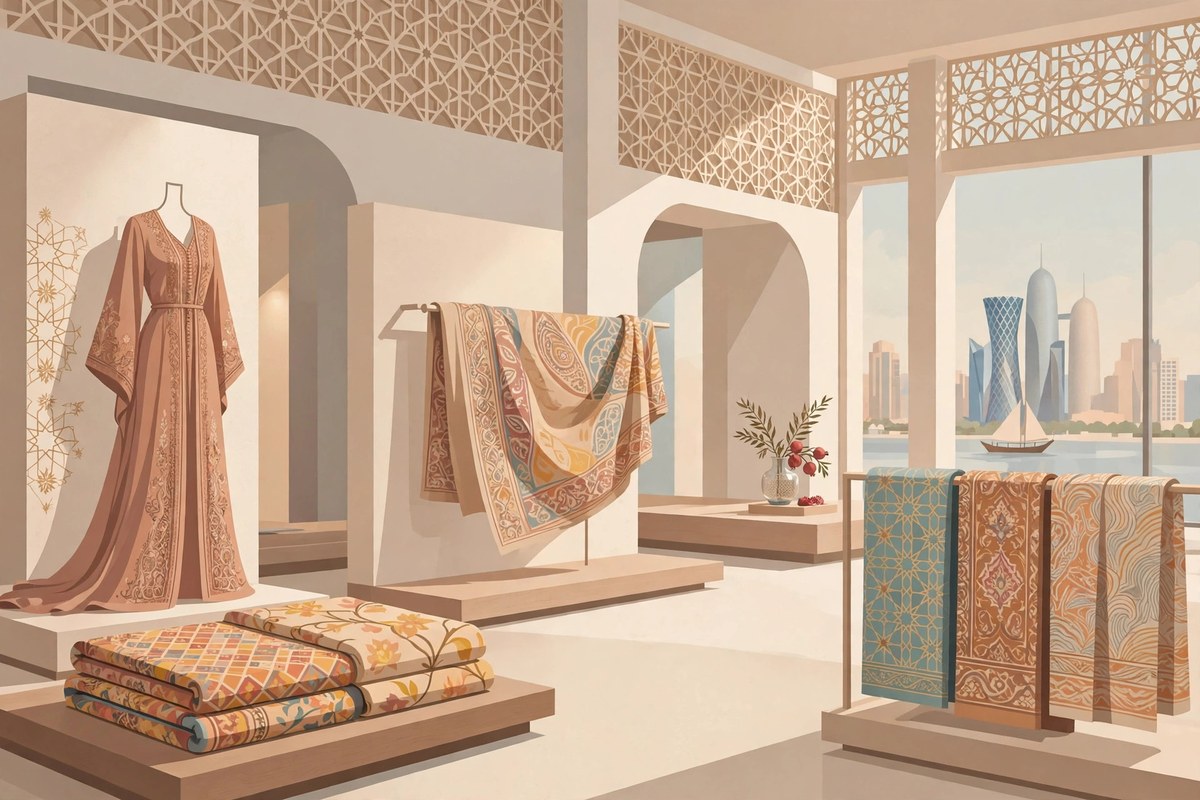
Some books are meant to be read quietly, alone. Wahy Al-Qalam is now being read out loud in a different language altogether: silhouette, embroidery, colour, paint and textile. In Doha, that translation is the exhibition itself.
Fables in Fashion 2026, presented by Qatar Reads, an initiative of Qatar National Library, takes a major work by Egyptian writer and poet Mustafa Sadiq Al-Rafi'i (1880-1937) and hands it to makers rather than only to readers. The exhibition is held in collaboration with the National Museum of Qatar, with the Ministry of Culture as strategic partner, and is on view in Temporary Gallery 1 until 28 November 2026.
That framing matters. This is not a display of costumes from a story. The garments and artworks are responses: each maker was asked what this book looks like when it leaves the page, and the answers do not agree — which is part of the point.
What happened
Qatar's national news agency reported the opening in early November, with the chairperson of Qatar Museums and the president of Qatar National Library present. The show brings together seven fashion designers and 30 visual artists, a deliberately uneven pairing: a small number of designers working at full garment scale, and a much larger group of visual artists working across painting, textile art, illustration and mixed media.
Reports name participating designers and artists including Ahmed Al Zahed, Amna Al Misned, Wadha Al Athba, Ghada Al Suwaidi, Aliya Al Obaidly and Abdulla Al Fakhroo. The interest lies less in any single name than in the range of approaches: one maker may work from a single image, another from a mood or a moral question raised by the book.
The show is also described as unfolding in three interconnected environments reflecting influences on Al-Rafi'i's literary life and the cultural atmosphere of early twentieth-century Egypt. That structure gives visitors a way in that is not purely chronological or purely visual: the book is placed in a time and a place, and then the contemporary responses are allowed to speak back to it.
Why a book about words works in cloth and colour
Wahy Al-Qalam is a collection of essays, stories and reflections, and its themes are broad enough to survive translation into another medium: identity, society, morality, spirituality, relationships and human emotion. Those are not plot points that can be illustrated literally. They are questions, and questions travel well between forms precisely because they do not come with a fixed image attached.
Fashion is a useful test for that idea. A designer working from a text must decide what to keep and what to let go. Silhouette can suggest restraint or excess. Textile can suggest softness, weight or wear. Embroidery can carry a pattern that repeats like an argument, or a detail that only reveals itself up close. Colour can do the work of tone in prose: warm, severe, muted, loud. None of these choices is a direct illustration, and that is why they can feel like reading rather than decoration.
Visual art works in a similar way, but with a different kind of freedom. A painting or a textile piece does not have to be worn, fitted or finished to a functional standard. It can stay ambiguous in a way a garment, which must hold together on a body, sometimes cannot. Putting both kinds of work in the same gallery therefore creates a useful tension: one side of the room is thinking about how an idea can be lived in, and the other about how it can simply be looked at.
There is a quieter point here too. A classic presented only through translation can feel like homework. This show invites a visitor who may never have read Al-Rafi'i to meet his concerns first through material and image, and only then, perhaps, through the text.
The show, at a glance
For readers planning a visit, or simply trying to place the exhibition, the confirmed details are straightforward. No further claims are needed to understand what kind of show this is.
| Detail | Confirmed |
|---|---|
| Exhibition | Fables in Fashion 2026, fifth edition |
| Venue | National Museum of Qatar, Temporary Gallery 1 |
| On view until | 28 November 2026 |
| Source book | Wahy Al-Qalam, by Mustafa Sadiq Al-Rafi'i (1880-1937) |
| Fashion designers | Seven, each with an original response |
| Visual artists | 30, across painting, textile art, illustration and mixed media |
| Presented by | Qatar Reads, an initiative of Qatar National Library |
| Campaign | One Book, One Doha 2026-2027 |
The trade-offs: translation always loses something
It would be dishonest to present this kind of exhibition as a pure gain. Translating a book into fashion and art necessarily simplifies it. A garment cannot carry a paragraph of argument. A painting cannot reproduce the rhythm of an essay. A visitor who only sees the show will understand something real about the book's concerns, but will not have read the book. That is a loss, and it is worth naming plainly.
The counter-argument is that reading itself is not a single act. People come to a difficult or distant text through many doors: a teacher, a film, a song, a conversation, a museum visit. An exhibition that makes a classic visible and discussable can lower the barrier to the text, even if it cannot replace it. The risk is not that the show simplifies the book; the risk is that visitors mistake the simplification for the whole book and stop there.
That is why the campaign structure matters. Fables in Fashion is part of One Book, One Doha 2026-2027, a campaign built around shared exploration of a single work over two years. The exhibition is one chapter in that longer conversation, not the conversation itself — a doorway, best judged by whether people walk through it.
What happens next
The exhibition itself has a clear end date: 28 November 2026. After that, the objects will leave Temporary Gallery 1, but the campaign they belong to does not end on the same day. One Book, One Doha is framed as a 2026-2027 cycle, built around a single work explored by a community over two years, so the reading conversation the show is part of is designed to outlast the gallery hang.
For other reading projects, the signal is practical: a classic does not always need a bigger marketing budget to find new readers; sometimes it needs a different room. Put a book beside garments and paintings, let makers disagree about it in public, and give people a reason to talk about it that is not a test.
What is Fables in Fashion 2026?
Fables in Fashion 2026 is a multidisciplinary exhibition at the National Museum of Qatar in which seven fashion designers and 30 visual artists each created an original response to Mustafa Sadiq Al-Rafi'i's Wahy Al-Qalam. It is the fifth edition of Fables in Fashion.
What is Wahy Al-Qalam about?
Wahy Al-Qalam is a collection of essays, stories and reflections by Egyptian writer and poet Mustafa Sadiq Al-Rafi'i. Its themes include identity, society, morality, spirituality, relationships and human emotion.
When and where can I see Fables in Fashion 2026?
Fables in Fashion 2026 is on view in Temporary Gallery 1 at the National Museum of Qatar until 28 November 2026.