

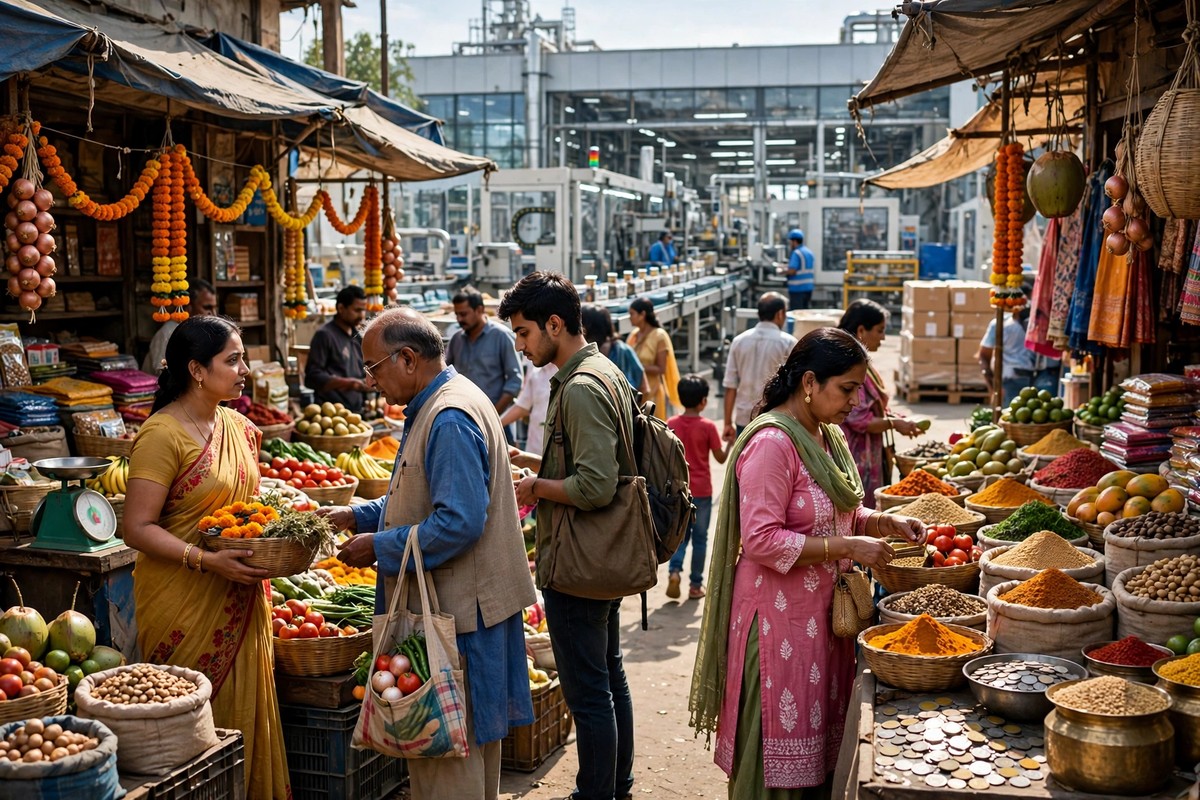
India collected ₹2.31 lakh crore in Goods and Services Tax in a single month. It is a number large enough to lose meaning on first reading, so start with what it is not: it is not a record. It is the second-highest monthly GST collection ever, second only to about ₹2.43 lakh crore in April, and the second consecutive month above ₹2 lakh crore. That correction matters, because the story here is not a broken record. It is a festive economy spending again, at a pace that is strong but not unprecedented.
💰 30-Second Signal — read this, you get the story
⚡October GST was ₹2.31 lakh crore — the second-highest ever, NOT a record.
🎯Factory output (IIP, September) grew 6.7%, with manufacturing up 7.6%.
🔭Mining fell 6.2% — the drag inside an otherwise strong month.
Tap to reveal what happens next →
Whether festive demand holds in the next GST and factory-output releases, and whether mining recovers.
Tap, scroll and watch the numbers — the full story, with sources, is below. All figures are from the article, no new claims added.
Alongside the tax numbers came a second, quieter signal: factory output grew 6.7% in September, slower than in August. Put together, the two releases tell a coherent story. Consumption, at least in October, was buoyant. Production, in September, was growing but cooling. Neither number alone explains the Indian economy. Together, they give a sense of its direction: spending up, factories steady, with some soft spots underneath.
What the GST numbers actually say
Gross GST collections in October 2026 were ₹2.31 lakh crore, up 22.9% year-on-year, according to provisional government data released on 1 November. That is the fastest year-on-year growth in the current fiscal year, and it follows a festive month in which consumers spent heavily. Net GST, after refunds of ₹27,934 crore (up 6.5%), was ₹2.03 lakh crore, up 25.6%. Small rounding differences exist between outlets — some report net growth at about 26% — but the direction and scale are consistent.
The split underneath the headline is revealing. Domestic collections were ₹1.59 lakh crore, up 15.8%. Import-related collections were ₹72,246 crore, up 42.2%, a much faster rise that reflects both import volumes and values. By component, Central GST was ₹42,935 crore, State GST was ₹51,340 crore, and Integrated GST was over ₹1.37 lakh crore. For the April to October period as a whole, gross collections were ₹14.77 lakh crore, up 13.2%, and net collections were ₹12.69 lakh crore, up 12.6%.
Maharashtra remained the highest-collecting state, with ₹35,150 crore, up 13%. That is not surprising — Maharashtra is India's largest state economy — but it is a useful reminder that national GST figures are an aggregate of very different state stories. A national record, or near-record, does not mean every state grew at the same pace.
Why October was so strong: festive spending
The Economic Times linked October's strength to festive demand, and the supporting indicators point the same way. Passenger car sales rose about 14% to a record of more than 525,000 units in October. Unified Payments Interface and digital payments reached 25.47 billion transactions, up 23%, with a value of ₹31.53 lakh crore, up 16%. Power consumption was about 160 billion units, up 22%.
None of those indicators alone proves that households are confident, but together they paint a picture of an economy in which people were buying, travelling and paying digitally at a high rate during the festive season. Tax collections follow spending, with a lag and with exceptions, so a strong October for GST is consistent with a strong October for consumption. It does not, by itself, prove that growth will stay at this pace in November or December, when the festive impulse fades.
Factory output: growing, but slower
The Index of Industrial Production (IIP) rose 6.7% year-on-year in September 2026, according to National Statistics Office data released on 28 October. That is down from a revised 7.8% in August — some reports cite an 8% quick estimate for August — and it is the second half of this story: production growing, but at a slower pace than the month before.
| Indicator | Figure |
|---|---|
| Gross GST, October 2026 | ₹2.31 lakh crore, +22.9% YoY, second-highest ever |
| Net GST, October 2026 | ₹2.03 lakh crore, +25.6% YoY |
| Domestic GST | ₹1.59 lakh crore, +15.8% |
| Import GST | ₹72,246 crore, +42.2% |
| April–October gross GST | ₹14.77 lakh crore, +13.2% |
| IIP, September 2026 | +6.7% YoY |
| Manufacturing | +7.6% |
| Electricity and gas | +11.2% |
| Mining and quarrying | −6.2% |
Within industry, manufacturing rose 7.6%, and electricity and gas supply rose 11.2%. Mining and quarrying fell 6.2%, with late monsoon disruption cited as a factor. The IIP index stood at 124.3, against 116.5 a year earlier, and April to September growth was 6.8%. Standout sectors included electrical equipment, up 33.9%, motor vehicles, up 19.0%, and rubber and plastics, up 19.9%.
Those sector details matter because they show where growth is coming from. Electrical equipment and motor vehicles are consistent with the festive and infrastructure stories: people buying vehicles and appliances, and businesses investing in equipment. Mining's fall, by contrast, is a reminder that weather and geology still shape industrial output in ways that policy announcements do not.
What ₹2.31 lakh crore means for prices, jobs and your wallet
For most readers, the question is not the tax total itself, but what it implies. A strong GST month gives the government more fiscal room — more revenue to spend on roads, schools, hospitals and other public services without new borrowing, or to manage its deficit. It does not automatically mean lower prices, higher wages or more jobs, and it should not be read as a promise of any of those things.
For prices, the link is indirect. Strong festive demand can support prices, especially if supply is tight, but GST itself is a tax on transactions, not a price index. For jobs, factory output is a better guide than tax: manufacturing growing at 7.6% is positive, but a slowing IIP suggests that hiring and production plans may be more cautious than the festive spending numbers alone would suggest. For households, the most relevant translation is simpler: October was a month in which India spent a lot, and the tax system captured a large share of that spending.
There is also a caution in the provisional nature of the GST figures. Provisional data can be revised, and small differences between outlets are normal at this stage. The headline — ₹2.31 lakh crore, up 22.9%, second-highest ever — is robust across outlets. The decimal points around it are less so, and this article does not overstate their precision.
What to watch next
The next GST release, for November, will be the first test of whether October's strength was festive or durable. If collections stay above ₹2 lakh crore without a festival boost, that would suggest underlying demand is stronger than seasonal. If they fall back sharply, October will look, in retrospect, like a festive peak rather than a new plateau.
Similarly, the next IIP release will show whether September's slowdown was a blip — weather-related, in mining — or the start of a cooling trend in manufacturing. Watch manufacturing in particular: if it holds near 7% or above, the factory story remains solid. If it slips further, the gap between festive spending and factory growth will widen, and that gap is where economic debates usually begin.
For now, the signal is balanced. India collected the second-highest GST ever in October, factories grew in September but more slowly, and the festive economy spent freely. That is a strong month, not a record month, and not a boom without caveats. It is exactly the kind of number that deserves a plain-English translation, not a superlative.
Was October 2026 GST a record?
No. Gross GST of ₹2.31 lakh crore in October 2026 was the second-highest monthly collection ever, second only to about ₹2.43 lakh crore in April. It was the second consecutive month above ₹2 lakh crore, and it grew 22.9% year-on-year.
How much GST was collected net, after refunds?
Net GST was ₹2.03 lakh crore, up 25.6% year-on-year, after refunds of ₹27,934 crore. Domestic collections were ₹1.59 lakh crore and import-related collections were ₹72,246 crore.
How did factory output perform in September 2026?
The Index of Industrial Production rose 6.7% year-on-year in September, down from August. Manufacturing rose 7.6% and electricity and gas rose 11.2%, while mining and quarrying fell 6.2%.