

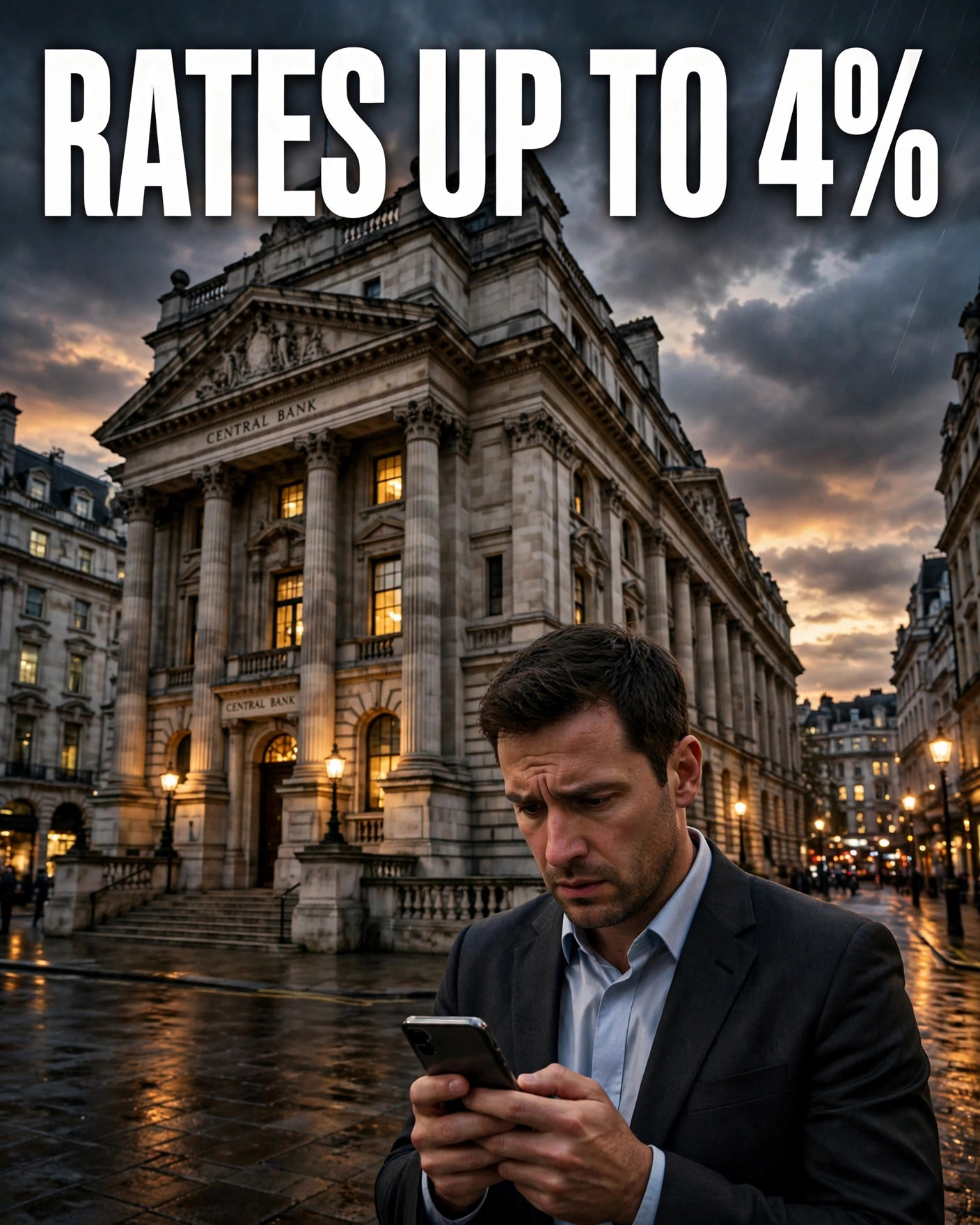
A major central bank has flipped. After years of holding and cutting, the Bank of England raised interest rates on 5 November 2026 — and it did so not because the British economy is running hot, but because a war in the Middle East is pushing energy prices up and, with them, inflation. It is the first Bank of England hike in over three years, it came with a warning that more may follow, and it sets up a difficult winter for borrowers in Britain.
What the Bank did
The Bank of England raised Bank Rate by 0.25 points, from 3.75% to 4%, on Thursday 5 November 2026 — its first rate rise in over three years, the first since August 2023. The decision was reported by Reuters, Business Standard and MoneySavingExpert.
A quarter-point rise sounds small, and in isolation it is. Bank Rate is the rate the Bank charges commercial banks, and it feeds through — with a lag, and not always one-for-one — into the rates households and businesses actually pay on mortgages, loans and savings. The significance of this move is not the size of the step, but the direction: after a long period in which the Bank was holding rates or cutting them, it has started raising them again.
The vote — and the dissenter who wanted more
The Monetary Policy Committee voted 8–1 in favour of the rise. The single dissenter, Catherine Mann, wanted a bigger half-point rise to 4.25%, not a hold. That detail matters, because it tells you where the disagreement on the committee sits: not between raising and holding, but between raising a little and raising more.
For comparison, in September the committee had held at 3.75% by 6–3 — a much more divided vote, with three members wanting a different course. The shift from a 6–3 hold in September to an 8–1 hike in November is a sharp change in the committee’s centre of gravity, and it happened in a single meeting.
Why now: energy prices and a war in its ninth month
The reason, as reported by Reuters, is the conflict in the Middle East, now in its ninth month, and the energy prices it is pushing up. Energy is one of the fastest ways a distant conflict reaches a British household: higher oil and gas prices feed into fuel, heating and electricity, and from there into the prices of almost everything that has to be transported, heated or made.
The numbers frame the problem. UK consumer price inflation was 3.5% in September, and the Bank expects it to reach around 5% by mid-2027. A central bank that raises rates when inflation is already above its target and forecast to rise further is doing the conventional thing — making borrowing more expensive to cool demand — but it is doing it at a moment when the cause of the inflation is largely outside Britain’s control, which is why the decision is as much about expectations as about the economy itself.
What the Bank warned — and what comes next
The Bank warned at least one more increase was likely if the US-Iran conflict continues. That is a conditional warning, tied explicitly to the conflict, not a promise of a set path. If the conflict eases and energy prices fall, the case for another rise weakens; if it continues, the Bank is signalling that it will act again.
The next decision is on 17 December 2026. Between now and then, the data the committee will watch includes energy prices, the next inflation readings, and any change in the conflict itself. One local report said the rise was the first since August 2025; that conflicts with Reuters and Business Standard, which say the first since August 2023, and this article follows the Reuters version — the first hike in over three years.
What was not in the sources checked for this article is the wider market reaction in the UK — the pound, gilts and mortgage pricing — and it is not reported here. That reaction will be visible in the days after the decision, and it is the part of the story that will matter most to British borrowers.
What did the Bank of England do on 5 November 2026?
It raised Bank Rate by 0.25 points, from 3.75% to 4% — its first rate rise since August 2023.
How did the MPC vote?
8–1 in favour of the rise. The dissenter, Catherine Mann, wanted a bigger half-point rise to 4.25%, not a hold.
When is the next Bank of England decision?
17 December 2026. The Bank warned at least one more increase was likely if the US-Iran conflict continues.